Wolfram Prufer
The Zone of InterestWolfram Prufer is the Lagerfuhrer and second-in-command at the Zone of Interest, a young officer whose bureaucratic rank sits uneasily beside Paul Doll’s contempt for his competence. He appears at moments when mass violence is made into a problem of staffing, calculation, and reporting. Prufer can object that an order cannot be carried out, yet he remains inside the command structure that carries it out; later, as an unimpeachable Nazi, he also becomes one of Doll’s sources on the war’s deteriorating prospects.
Identity and Position
Doll describes Prufer as barely thirty, handsome in a vacant, toneless way, bereft of initiative, and given to sloth. The assessment is openly self-serving: Doll agrees with the claim that the Zone of Interest is a dumping ground for second-rate officers only so long as the accusation does not reflect on his own command. Prufer’s rank nevertheless makes him Doll’s Lagerfuhrer and number two. The contrast between authority and perceived incapacity is central to his characterization: he occupies a position of substantial responsibility, while Doll persistently casts him as a weak subordinate.
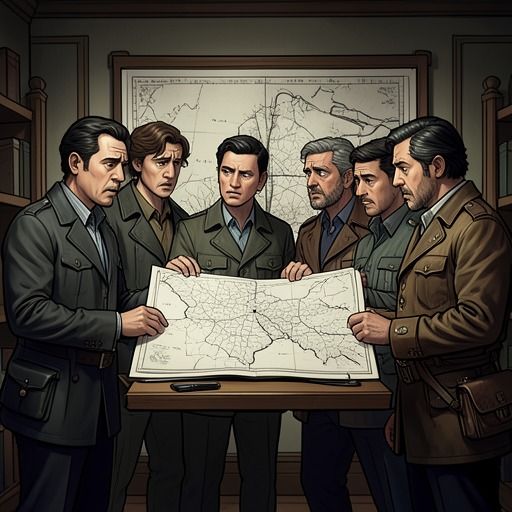
Prufer’s place in the institution is visible in the scale of the operation around him. As Doll prepares to receive Special Train 105, he presents himself with Prufer at his side and assembles labor managers, physicians, disinfectors, Szmul and his twelve-man Sonderkommando team, Kapos, a hosing crew, troops under Boris Eltz, a heavy-machine-gun unit, flamethrowers, Ilse Grese’s platoon, and a septet of violinists. The train’s arrival is treated as a managed procedure, with Doll already considering the usual passenger-per-train estimate and the likely proportion sent to the left. Prufer is named as the deputy within this apparatus, not as its architect; the scene nonetheless places him within the administrative machinery prepared to receive and sort the deportees.
Orders and the Work of the Camp
Prufer’s clearest direct challenge to Doll concerns an order Doll insists must be obeyed. Prufer calls the task impossible and says it cannot be done. Doll answers that the order comes from Horst Blobel and therefore, in his account, from Heinrich Himmler. He rejects the very category of impossibility and invokes the SS demand to rise above objective conditions. Prufer’s objection registers a practical limit, not a refusal of the institution or its violence: the exchange ends with him asking what the point of the task is, while Doll treats obedience as its own justification.
The broader context is the disposal of bodies at Spring Meadow. When Doll visits the field with Prufer and other officials, the sound and smell of the burning reach them from beyond a mound. Prufer reports that Horst Blobel had tried to destroy bodies by blowing them up at Culenhof, without success. The report places Prufer in the flow of operational information about attempts to dispose of evidence, though the account does not say that he devised or carried out those methods. Doll’s response is to demand the purpose of the failed attempt, exposing the managerial language through which the destruction is discussed.
The narrative also describes the Sonderkommando prisoners’ work in brutal procedural detail: they drag bodies from the shower room to the Leichenkeller, remove gold teeth, hair, earrings, and wedding rings, load bodies toward the furnaces, grind the ashes, and send the powder by truck to the River Vistula. These are not tasks attributed specifically to Prufer. Their presence in the account, however, defines the system over which he holds the second-highest camp position: mass murder is followed by a chain of labor, extraction, burning, and disposal, while Doll’s administration describes the people forced to perform it through the language of utility and callousness.
Reporting and Violence Against Prisoners
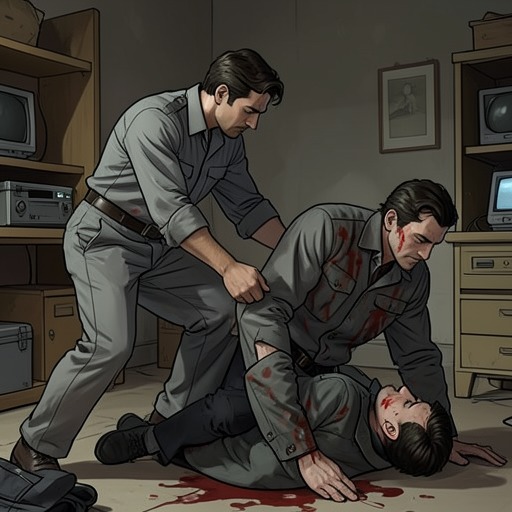
Prufer also appears in the account of Bohdan Szozeck’s assault on Doll. The explanation for Doll’s black eyes travels through a chain of intermediaries: Bohdan’s Blockaltester reports what Prufer’s adjutant heard from Prufer, who in turn received the story from Doll. In this version, Bohdan struck the Commandant with a gardening tool. The account is therefore not presented as direct, independently verified knowledge; its relay through subordinates ultimately leads back to Doll himself.
Bohdan is put on a train with the next transport that same night. The narrative links his fate to the extreme imbalance of power in the camp: a prisoner who strikes the Commandant cannot expect to survive, and Doll’s authority makes the assault a matter of example as well as punishment. Prufer is part of the chain through which the story is transmitted, but the text does not say that he ordered Bohdan’s removal or personally carried it out. That distinction matters in a world where information, orders, and lethal consequences pass through ranks, while responsibility is easily obscured by the chain itself.
Prufer’s reporting role is clearer after the execution of Polish prisoners at Bunker 3. Doll, ill and recovering after a visit to the bunker, receives Prufer late that night in his dressing gown and offers him alcohol before asking how the operation went. Prufer reports that it went smoothly. In the yard, a small group of the prisoners had chosen to fight behind a quickly overrun barricade; the other 291 men were shot between 17:10 and 17:45. Prufer’s brief report turns an execution into an operational result, and Doll’s question-and-answer exchange gives the killing the cadence of routine business. The evidence establishes Prufer’s report, not his personal participation in the shooting.
The War and the Limits of His Dissent
Prufer’s political reliability becomes especially useful to Doll as news from the Eastern Front grows uncertain. Doll distrusts the silence from Berlin and finds other officers unhelpful as sources. Prufer, despite the faults Doll attributes to him, is described as an unimpeachable Nazi. His brother Irmfried is on Friedrich Paulus’s staff, and mail is, at least as Christmas approaches, the only thing getting in and out of Stalingrad. Prufer assures Doll that Germany will prevail by appealing to the supposed contempt of the German soldier for objective conditions—the same kind of reasoning Doll had earlier used to dismiss Prufer’s practical objection to an order.
After going home for Christmas, Prufer returns and confirms that Paulus’s forces have been encircled for well over a month. His answer gives Doll a concrete fact that official silence and confident assurances had failed to provide. The contrast does not turn Prufer into an opponent of the regime: his political credentials remain firm, and his information comes through a family connection entangled with the military disaster. Instead, his scenes show the distance between ideological certainty and the facts arriving through personal and administrative channels.
Narrative Function
Prufer is drawn less through private life than through his place in Doll’s systems of command and explanation. Doll calls him useless when he wants to belittle him, but relies on him as deputy, recipient of orders, reporter on operations, and source of military news. His objections are real but limited: he names impossibility and asks what an order is for, yet the narrative supplies no break with the camp or its Nazi purpose. His later confirmation of encirclement similarly punctures the regime’s confidence without making him a dissenter.
That tension makes Prufer a measure of institutional routine. At the ramp, his rank belongs to the organized reception of deportees; during the disposal crisis, he carries information about failed methods; after Bunker 3, he reports the execution as smooth; and at Christmas, his connections bring news that official optimism cannot erase. The narrative gives no account of his postwar fate. His ending therefore remains outside the story’s record, while his documented role remains inside its machinery: subordinate to Doll, capable of registering practical limits, and still implicated in the system whose operations he reports.